About 36 million years ago, a flood-swollen river swept enormous fir, cypress, and maple logs across what is now central Mississippi and buried them in sand. Over millions of years, minerals slowly replaced the wood until the logs turned to stone. Today those stone logs rest in the woods outside Flora at the Mississippi Petrified Forest, one of only two petrified forests in the eastern United States; the other is the Gilboa Fossil Forest in New York.
It’s a small, fascinating place, and it’s only about 45 minutes from our front porch at Oak Hall. That makes it one of the easiest nature outings to add to a Vicksburg getaway. Here’s what to know before you go, from the trail and museum to hours, admission, and the photo spot everyone lines up for.
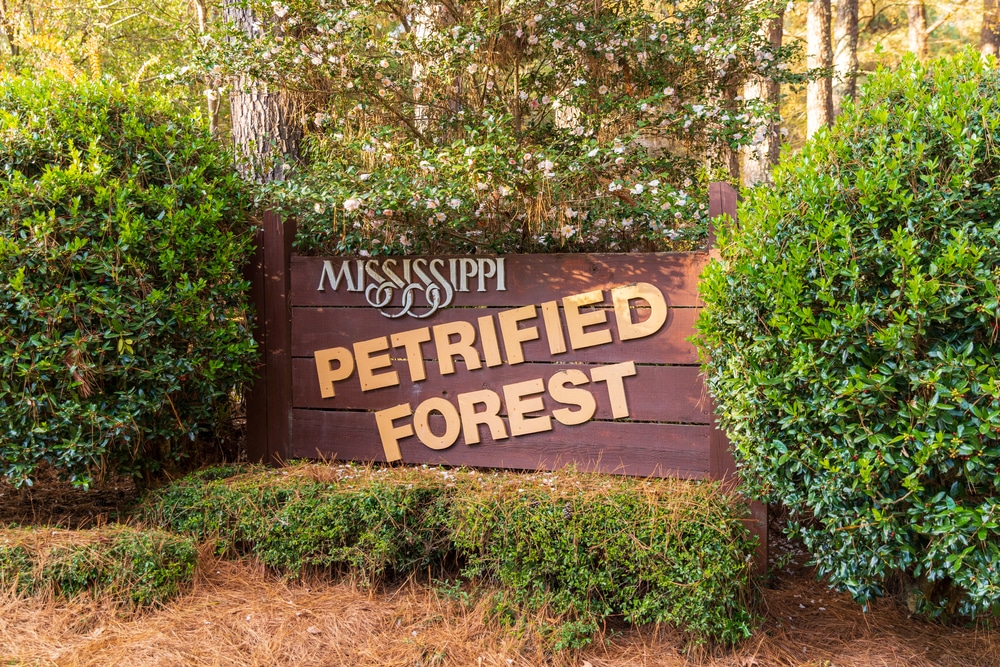
What is the Mississippi Petrified Forest?
Petrified wood forms when a fallen tree is buried quickly enough that it can’t rot. Groundwater rich in dissolved minerals seeps through the buried wood, and over time those minerals replace the original plant material until the log is essentially a fossil. Geologists have identified several tree types on the property, including extinct palms, firs, and sequoias. Based on the logs’ size, some of these trees likely stood more than 100 feet tall.
People have known about the forest since the mid-1800s, when erosion began exposing the logs. For about a century, visitors carried pieces home as souvenirs, and many specimens were lost. That changed in 1962, when Bob and Shirl Schabilion bought the land to protect what remained, and they opened it to the public a year later. The forest was named a National Natural Landmark in 1965. In 1976, Mississippi made petrified wood its official state stone. One detail makes a visit feel special: nothing on the trail has been moved. Every log lies exactly where erosion uncovered it.
Walking the Nature Trail
The main attraction of the Mississippi Petrified Forest is the self-guided nature trail, about half a mile long. Most visitors spend around 30 minutes. With admission, you’ll receive a trail guide with numbered stops that highlight the area’s geology and history.
The path is wide and mostly shaded, and many of the logs are close enough to touch, so you can run your hand over stone that was once bark. Keep an eye out for wildlife as you walk, because deer and the occasional fox are regular visitors. Near the trail, you’ll also find a large cross-section of a sequoia trunk.
About half of the nature trail is paved; the other is packed dirt. The dirt section may be harder for wheelchairs, so there’s an accessible shortcut.
The Best Photo Spots in the Mississippi Petrified Forest
Head for the Caveman’s Bench. This giant petrified log lies right on the trail, and nearly everyone takes a seat for a picture. Right beside it, look at the old canyon wall, where several log sections are still embedded in the earth. They were all once part of the same enormous tree. For the best light and the coolest temperatures, go in the morning.

The Museum, Gem Mining & Gift Shop
The trail ends at the Earth Science Museum, which is small but interesting. It displays petrified wood from every state and several other countries, including fossilized leaves, fruits, cones, and bark. You’ll also find dinosaur footprints, whale bones, turtle shells, polished minerals, and mastodon bones discovered about nine miles from the park.
Kids, and plenty of adults, enjoy the gem mining flume, where you sift through rough material to find stones to take home. The gift shop is a good place to pick up fossils, local petrified wood, jewelry, and a snack for the drive back.
Is the Mississippi Petrified Forest Worth Visiting?
It depends on what you’re expecting. Here, the logs are large and earthy-colored, and they sit in a quiet Mississippi woodland, not the colorful desert badlands of Arizona’s Petrified Forest National Park.
If you enjoy natural history, have curious kids, or simply want a relaxed morning outdoors with a remarkable story behind it, the answer is yes. Plan on one to two hours for the trail, museum, and gem mining.
Hours, Admission & Tips for Your Visit
- Location: 124 Forest Park Road in Flora, about 45 minutes from Oak Hall.
- Hours: 9 a.m. to 6 p.m. from April 1 through Labor Day, and 9 a.m. to 5 p.m. the rest of the year. The forest is open year-round except Thanksgiving and Christmas.
- Admission: $7 for adults and $6 for students and seniors.
- Our tips: Wear closed-toe shoes, bring bug spray in the warmer months, and check the forest’s official website for any schedule changes before you go. Fall is our favorite season for this trip, since the countryside along the drive turns gold and red.
More Ways to Get Outdoors Near Vicksburg
There are plenty of options to get outdoors in every direction:
- The 16-mile tour road at the Vicksburg National Military Park is a favorite with walkers, runners, and cyclists. You can choose paved loops of around three miles or go the full length, passing monuments and cannon batteries along the way. For a tougher workout, the Al Scheller Hiking Trail follows a more demanding route through the park’s interior.
- Vicksburg Historic Trail is a 4.9-mile loop that winds through downtown, with plaques about the historic buildings you pass and markers from the Mississippi Blues Trail along the way. Be sure to stop at Catfish Row Art Park, where colorful murals tell the city’s story.
- About an hour north, the Delta National Forest has quiet trails through bottomland hardwoods, swamps, and seasonal wetlands.
- South of Vicksburg, the Homochitto National Forest is a good choice for hiking, fishing, birdwatching, and scenic drives.
- Across the river in Louisiana, the Tensas River National Wildlife Refuge is one of the best spots in the region for observing black bears, deer, and migratory birds.
- Poverty Point is an easy day trip for anyone curious about ancient history, with earthworks that are thousands of years old.
- For even more ideas, see our guide to the best things to do in Vicksburg.
Make Oak Hall Mansion & Boutique Hotel Your Home Base
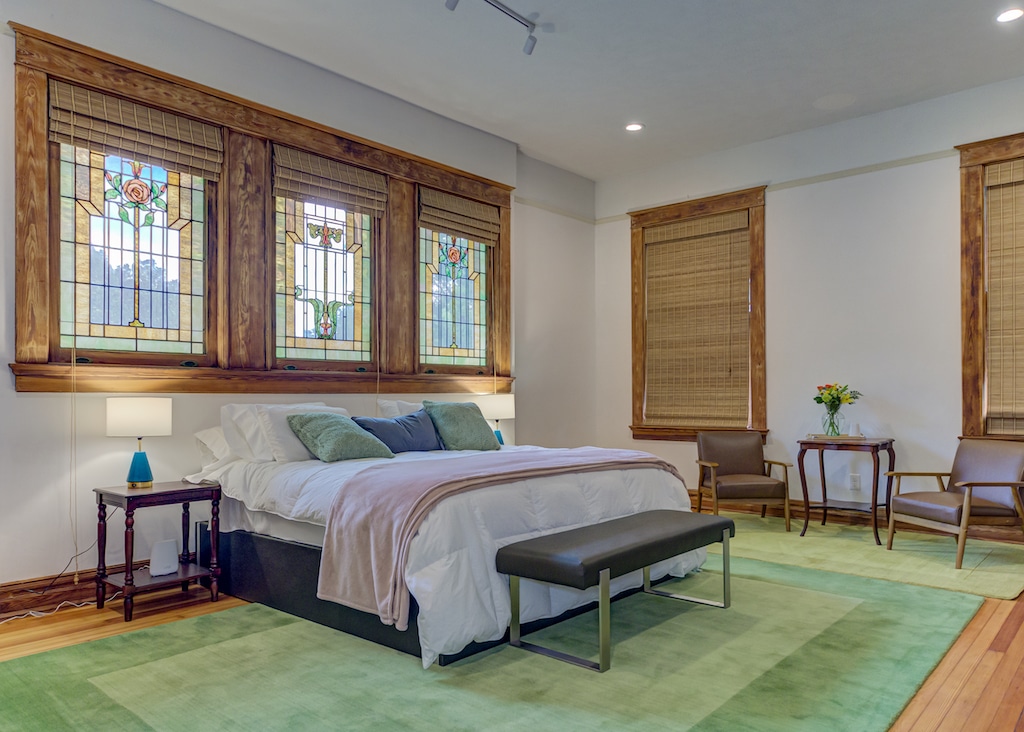
After a day of fossils and country roads, come back to a hot shower and a comfortable bed in our historic home. Fannie Willis Johnson built Oak Hall in 1910, and today it’s listed on the National Register of Historic Places. Look for the Mission-style gabled portico, the cartouches and carved blocks above the columns, the wide bracketed eaves, and the stained glass windows that scatter color across the rooms in the afternoon. Inside, we kept the history and skipped the fuss, so you won’t find dolls or doilies here, just clean, modern style in a house with more than a century of character.
Choose from three suites and two guest rooms, each with a private en suite bath and hotel-quality linens. Spend your evening by the pool, or settle onto the covered porch with a glass of wine in our quiet neighborhood. Guests remember the hospitality most. Don and Elizabeth restored this home themselves, and they’re always happy to help you plan, whether that means the best time to reach the forest before the crowds or where to eat downtown afterward. Check availability and make Oak Hall the home base for your Mississippi getaway.
Frequently Asked Questions
How far is the Mississippi Petrified Forest from Vicksburg?
It’s about a 45-minute drive. The forest is in Flora, in Madison County, just northwest of Jackson.
How long does a visit take?
The half-mile trail takes about 30 minutes. With the museum and gem mining, most visits last one to two hours.
How much does it cost?
Admission is $7 for adults and $6 for students and seniors. Groups of 15 or more pay $5 per person.
Can you touch the petrified logs?
Yes, many are close enough to touch, and visitors can sit on the Caveman’s Bench. Removing any petrified wood from the trail isn’t allowed.
Is the Mississippi Petrified Forest open year-round?
Yes. It’s closed only on Thanksgiving and Christmas.